By Anju
Director: Aaron Sorkin
Cast: Yahya Abdul Mateen II, Sacha Baron Cohen, Jeremy Strong, Joseph Gordon Levitt, Eddie Redmayne, Mark Rylance, Frank Langella, Michael Keaton, John Carroll Lynch, Alex Sharp, Daniel Flaherty, Noah Robbins
Language: English
Platform: Netflix
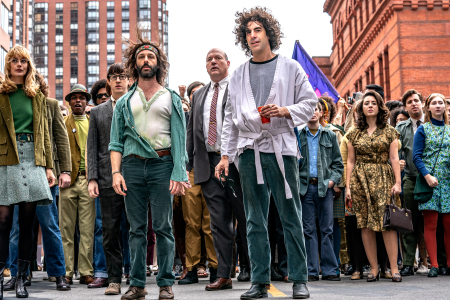
Indeed “the whole is watching” this film now. This is the oft-sounding chant in the ensemble star cast film by the master director Aaron Sorkin – The Trial of The Chicago 7, a historic true story about the wrongful trial of the seven (rather eight) who wanted to peacefully protest against the 1968 US-Vietnam war. In this largely courtroom drama, the incidents resonate to the present day scenario too.
The film opens with president Lyndon B Johnson announcing sending thousands of American men having December 30 birthdays, to fight American war at Vietnam. It is the 1960s and America is undergoing some major upheavals – revolutionary protests, civil unrest, the assasinations of Martin Luther King and John F Kennedy. Members of four organizations from various parts of the country are planning to carry out peaceful protests at Democratic National Convention, Chicago, condemning the war at Vietnam in the August of 1968 – Abbie Hoffman (Sacha Baron Cohen), founder, and Jerry Rubin (Jeremy Strong) are members of Youth International Party called the Yippies that bonds over rock music, public fornication; leader Tom Hayden (Eddie Redmayne) and Renny Davies (Alex Sharp) are members of Students for a Democratic Society called SDS; David Dellinger (John Carroll Lynch) is leader of National Mobilization Committee to End The War in Vietnam called MOBE; Bobby Seale (Yahya Abdul-Mateen II) National Chairman of Black Panther Party. These are non conformists and are arrested with the charges of crossing state lines with the intention of inciting riots, after some months.
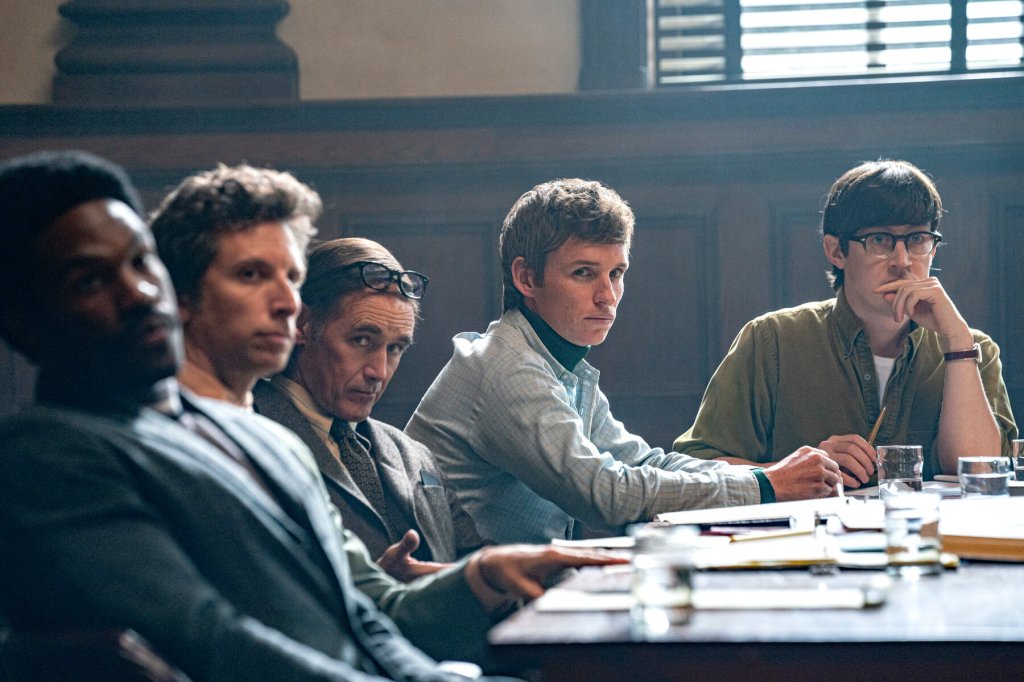
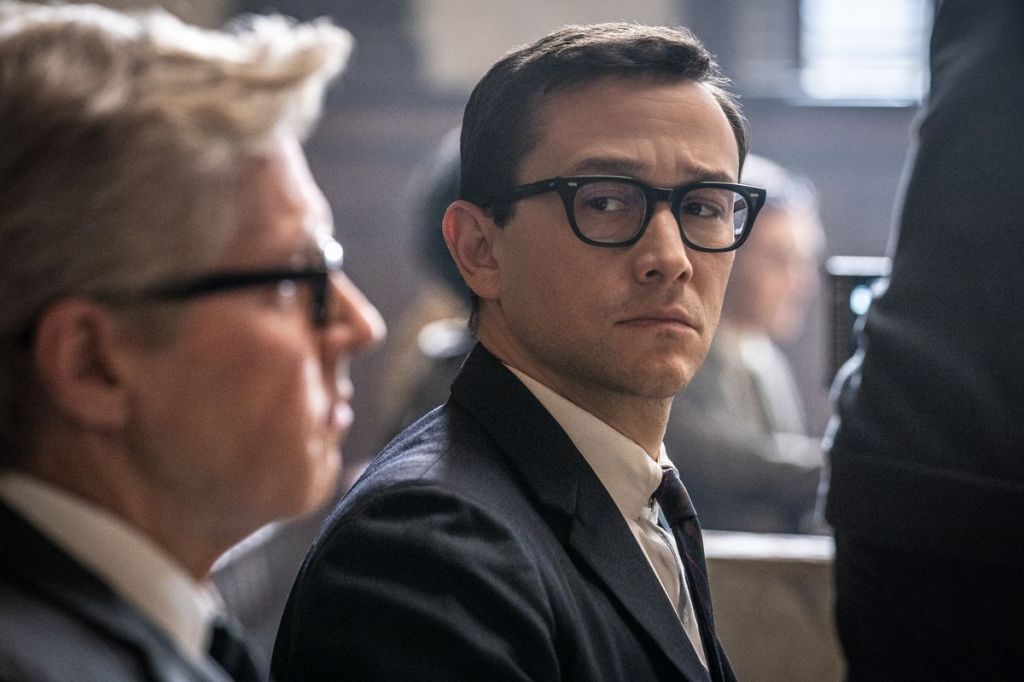
Now is 1969, there is a change in the government, with Republicans having won, Ronald Reagan is the new president. Tom Foran (J C Mackenzie) and Richard Schultz (Joseph Gordon Levitt) are appointed as public prosecutors by the Attorney General John Mitchell (John Doman) to arrest the defendants on charges of breaking federal law, restraining their free speech. Police were the ones to start it first, was the other side of the story. Massive protests erupt at the U.S. District Court to free the seven defendants. William Kunstler (Mark Rylance) and Leonard Weinglass (Ben Shenkman) are representing all defendants except Bobby Seale, who will be counseled by BPP Illinois Chairman, Fred Hampton (Kelvin Harrison Jr.) as his attorney isn’t able to represent him due to illness.
Judge Julius Hoffman (Frank Langella) takes over the courtroom with preconceived prejudice. The defendants especially Bobby Seale and Abe Hoffman were charged with many counts of contempt of court due to arguments in the trial that spanned over many months. The narrative of the film goes back and forth, to characterize the mood. In the scenes of Free Hayden protests, we see a charged atmosphere of protestors protesting against cops whom are referred to as “pigs”, someone in the crowd shouting something and they are directed with tear gas, baseball bats, a girl sitting over shoulder of some guy is beaten and unclothed, protestors hurt badly all by the cops. It’s a high intensity cinematic shot with red hued footages.
In one of the shocking turn of events, Fred Hampton from the BPP is shot and killed. Bobby Seale asks for cross examination and is gagged by Marshals and convicted. He isn’t given a chance to speak and is repeatedly shunned. Everyone in the court including Schultz shows their displeasure over these developments. They appeal to the judge the case be turned as a mistrial but the idea is discouraged. The Attorney General during the riots, Ramsey Clark (Michael Keaton in a cameo), testifies that he isn’t seeking indictment and states that the riots were started by the Chicago Police Department and there was no conspiracy by the defendants to the riots. There starts contempt for the government. In the final scene where the seven defendants are brought to be sentenced, they are wearing white, which denotes seeking justice. It should be drawn attention to the fact that in addition to more than 4500 American troops killed in Vietnam, casualties were also from the Vietnamese side.
America in particular and world in general is witnessing protests, civil unrest, destruction to properties, people, even to this day. The film very largely is timely, shows how far we have come since the 60s and nothing has changed significantly. The “Black Lives Matter” protest movement after the killing of George Floyd and many more black people is an ongoing one. The film is an allegory to such movements, where the protesters are being meted out the same treatment as the defendants in the film. This doesn’t pertain only to black people – it is a world problem across various other race, religion, caste, creed, gender, politics, spirituality and nationality.
Though the film is a serious courtroom drama, there are some scenes that cause us to laugh coming from Abbie played by Sacha who is known for his comic timing. He is the one who steals the show when we leave from watching the film. All other performances are absolutely solid. Yahya’s eyes are enough to display all the heartbreaking emotions he is going through inside. Jeremy with his distinct personality provides support to Sacha standing beside him all the time. Eddie exudes swag and confidence in his role. JGL is a pleasure to watch always and here with his conscience oriented prosecutor role. He is forthright in the scene when the verdict is pronounced. Frank Langella is classy as a menacing judge. Mark Rylance is just fantastic. Michael Keaton is a delight in his two scene role. Daniel Pemberton’s score is top notch, creates enough tension w.r.t. the events being unfolded. Alan Baumgarten’s editing is crisp, cuts out what isn’t needed. Colour tone both during the trial in the courtroom and when protests are taking place, suit the occasions.
Stars: ***.5
 My thoughts