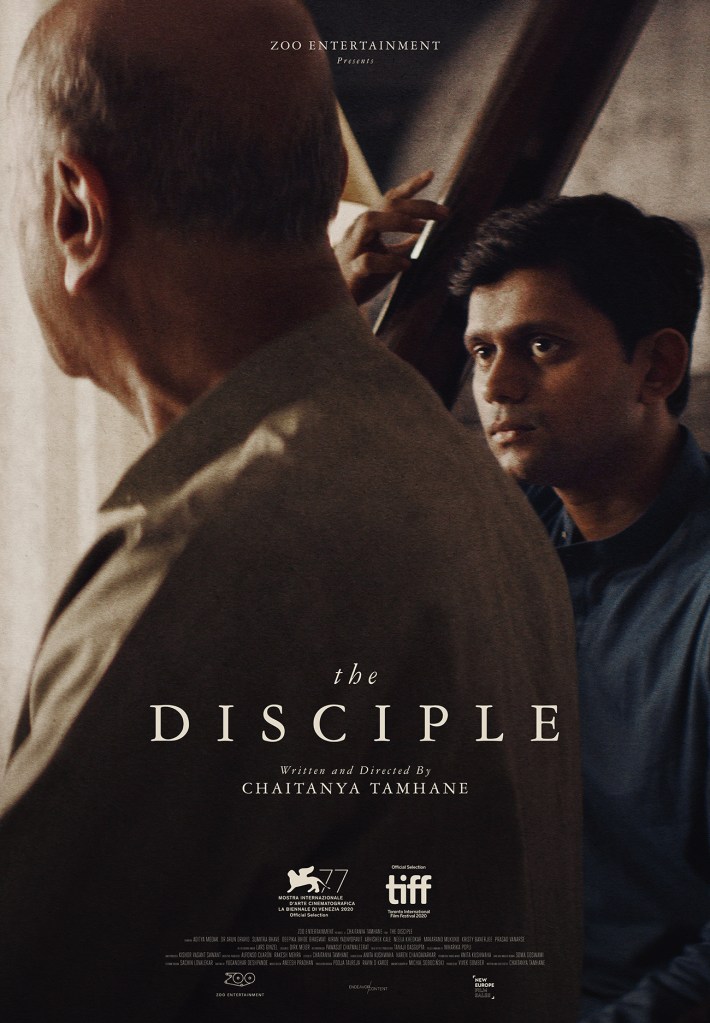
By Anju
Director: Chaitanya Tamhane
Cast: Aditya Modak, Kiran Yadnyopavit, Sumitra Bhave, Arun Dravid
Languages: Marathi, Hindi, English, Gujarati, Bengali
Year: 2020
Tanpura is still having a hypnotizing effect on me. It becomes a distinct and an indispensable character by itself in Chaitanya Tamhane’s musically tantalizing film, The Disciple, a journey of an Indian classical musician who is following the path of his father and gurus to make a mark of his own eventually figuring out if it can be achieved. The difficulties, struggles, dejection, rejections and despair he faces forms the film’s narrative.
Sharad Nerulkar(Aditya Modak) is an aspiring classical musician of Alwar gharana who regularly practices music with discipline and devotion. His musician father(Kiran Yadnyopavit) no more, his mother elsewhere, he lives with his grandmother in Mumbai. He works at a recording studio with his friend Kishore. He is deeply influenced by the wisdom about music from his late father and the ideals of maestro Vidushi Sindhubai, who’s known as Maai. He has her profound tapes, known as Maai tapes, that were recorded at lectures for musicians and knowledge pertaining to the gharana. The tapes speak about relentless practice to perfectionism, surrender, sacrifice, ascetism and not care about world recognition. These are the best scenes in the film where Sharad is on his motorcycle and Maai (legendary filmmaker Sumitra Bhave’s voice) tapes play at the background with haunting Tanpura reverberating. His Guru Vinayak(Arun Dravid) is a wizened man whom Sharad looks upto with utmost respect and reverence. He learns music from him, bathes him, tends to his medical needs and takes care of him almost highlighting guru-shishya relationship. His Guru expects Sharad to excel but always doesn’t find the latter upto the mark with his riyaaz. No matter how much he tries to match up with his gurus, Sharad falls short of it. He loses in a classical music competition, lacks the required alaaps during concerts with his guru, also not able to practice at length taking enough breaths. He leads a lonely life. His daily routine – works at friend’s, goes for riyaaz at his guru’s chawl, meditates at yoga class, practises music at home and indulges while watching porn. His gesture of love for Sneha(Deepika Bhide), a fellow musician, gets turned down. He has dedicated himself so much to be a practitioner of traditional classical music ,so that in one instance, he rebukes his grandmother saying he doesn’t want to take up a regular job and wants to keep at his riyaaz. He often recounts the times he played music with his father and revisits an interview tape of 1970 in which his father, quoting Maai, says gharana music should be played for pure discipline and it shouldn’t be for recording purposes.
In the second chapter of his life, Sharad undergoes amazing physical transformation. Sharad is in his 40s now with a moustache, slightly rounded up physique and has started taking classical music classes. He’s at agents looking for concerts to attend here and there while still failing to deliver – once even walking out of one, midway. He is scornful of fusion music, bands and reality music shows. Contrastingly, he keeps checking for himself online on social media for validation. Here he chances on Sneha, married and doing well for herself in music. Once his friend Kishore arranges a meeting with a music critic, to publish Maai tapes. During the meeting , Sharad patiently listens to what the critic has to say about artists’ egos, being highly protective of their music, and their different backgrounds, but gets infuriated when his gurus are talked about in a negative way. Later, it makes him retrospect if he really needs to continue treading the traditional path. He decides to donate all Maai tapes to a government library.
In the third chapter of Sharad’s life, we can see him in his middle age on a metro ride with his wife and daughter. He is bringing out CDs of classical Alwar gharana through a music company. The parting shot shows him in a local train and a chap from Rajasthan is passing around people playing Tanpura for his joy. People are clicking pictures and Sharad is sitting still absorbing it. This is to allude to the fact that real artistic talent gets lost with commercialism.
The Disciple is the second product from Chaitanya Tamhane, who has given us the award winning Marathi movie, Court. The film has already premiered in major film festivals across the globe. It has won best screenplay and FIPRESCI awards at the 77th Venice International Film Festival. India’s last FIPRESCI award was 20 years ago for Mira Nair’s Monsoon Wedding. At 2020 Toronto International Film Festival, it received Amplify Voices Award. It was also screened under main slate section at the 58th New York Film Festival.
Yugandar Deshpande has cast real musicians. Even the audiences at concerts are hand picked. It’s an impressive debut by Aditya Modak who is a musician himself. He performs with such restraint and wonderfully expresses through his eyes the angst, tension, helplessness and hopelessness. Arun Dravid is effortlessly natural for his aged character. Chaitanya’s screenplay is absolutely immersive and his editing seamless. Must mention main credit has to go to Vivek Gomber who envisioned the project. Renowned director of movies such as Gravity and Roma, Alfonso Cuoron, is the executive producer, under whom Chaitanya Tamhane much like a disciple himself, attended a workshop as part of Rolex Mentor and Protégé Arts Initiative. Michael Sobocinski’s each and every frame has perfect symmetry. The ones that stand out are the long slo motion wide angle ones focusing Sharad on his motorcycle, the balcony shot where he’s practicing and the concert by a lake. Aneesh Pradhan’s composition is mesmerizing. It unearths the richness of Indian classical gharana music. Sound design by Naren Chandravarkar is a treat to the ears. Production design by Pooja Talreja is visually stunning and beautiful.
Stars: ****.5
 My thoughts